
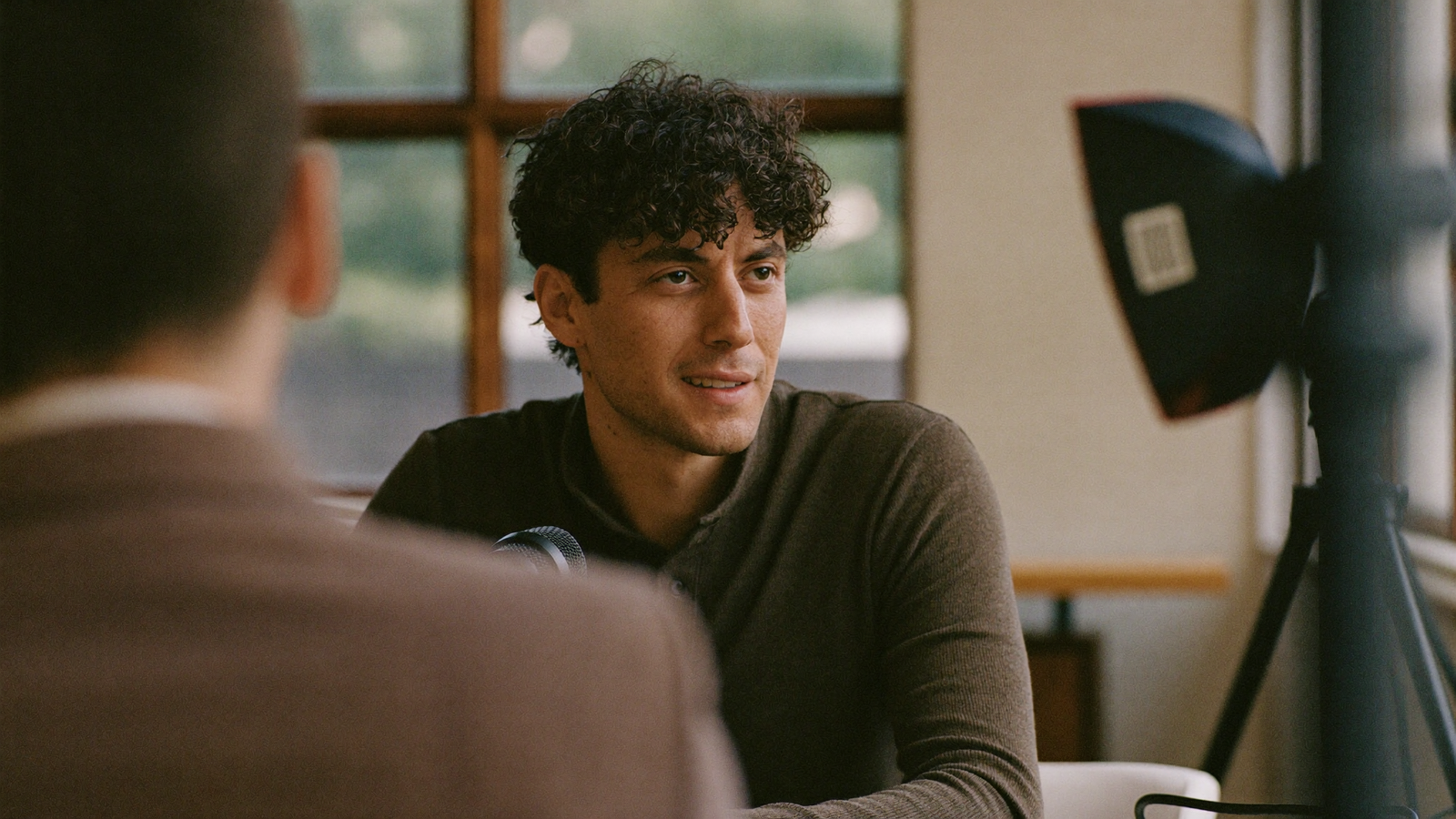
A guest who looks stiff on a business podcast almost never has a confidence problem. They have a production problem.
Nobody tells a law firm partner or a founder that before their first recording. So they assume the fix is personal: relax more, rehearse the answers, get some media training. Most of the time, none of that is what was actually missing.
What was missing sits upstream of the guest entirely: no run of show, no advance sight of the questions, one static camera with nowhere for the edit to hide a stumble. Fix those three things and most "nervous on camera" guests stop looking nervous.
The nerves are real. The cause usually isn't personality
Glossophobia, the fear of public speaking, is genuinely common. Around 77% of the general population reports some level of anxiety about speaking in front of others. In the UK, public speaking sits among the top three most commonly reported phobias, according to YouGov polling covered by Preply's 2024 survey of UK adults.
Job interviews and formal presentations, the two settings closest to what a podcast recording feels like on paper, were rated the most anxiety-inducing scenarios in that same survey. Forgetting words was the single most cited fear.
An executive who has never sat in front of a camera before is bringing something real into the room. But a podcast recording is not a formal presentation, and it is not a job interview. The anxiety a first-timer feels is usually a response to being treated like it is one.
Give someone a topic with no structure, no idea what's coming, and a single unblinking lens twelve feet away, and the forgetting-words fear from that survey activates almost on cue. That's not a personality trait showing up. That's a predictable response to an unmanaged situation.
The uncomfortable part for a lot of hosts and producers is that the guest's stiffness is frequently evidence of poor production, not poor preparation on the guest's part. A guest cannot be blamed for freezing when nobody told them where the conversation was going.
What a pre-interview brief actually needs to cover
A short pre-interview call, ten to fifteen minutes, a few days before recording, does more for how a guest looks on camera than any amount of on-the-day pep talk. It should cover four things specifically:
The shape of the conversation, not a script. A guest should know the two or three areas the conversation will move through and roughly how long each will run. They should not receive verbatim questions to rehearse against, because rehearsed answers sound rehearsed, which reads on camera as guarded rather than relaxed.
What "good" sounds like for this episode. A guest who understands the show is looking for one strong opinion per segment, not a comprehensive summary, stops trying to say everything and starts saying something. That single shift in brief does more for pacing than any coaching on delivery.
Logistics that remove low-level anxiety. Where to look, what happens if they lose their thread mid-answer, whether they can ask for a retake, how long the session actually runs. Small, practical answers, but each one removes a genuine unknown that would otherwise sit in the back of a first-timer's mind through the whole recording.
Permission to be imperfect. Telling a guest explicitly that stumbles, restarts, and "can I try that again" are normal and get edited out changes how they behave the moment they misspeak. Without that permission, a guest who fumbles a sentence tenses up for the next three questions, worried it happened on the record. With it, they shrug and carry on.
None of this is media training. It's project management, done a few days early instead of thirty seconds before the camera rolls.
Why the shot matters more than the guest's mood
A single static camera on a guest gives an editor exactly one thing to work with: whatever that guest actually said, in the order they said it. If they pause, restart a sentence, or need a second attempt, the only fix available is a jump cut, an abrupt splice that draws attention to the very moment everyone wanted hidden.
Multicam shooting, two or more angles recording simultaneously, and a stock of cutaway footage give an editor somewhere else to put the viewer's eye while a stumble is trimmed out underneath. As editors regularly point out when discussing this exact problem, cutting away to B-roll is the standard way to hide a jump cut, particularly when a subject "stammers or 'umms and uhhs' their way through an interview."
A second camera angle does the same job even without extra footage: cut to the other camera for a beat, cut back, and the edit reads as a deliberate creative choice rather than a repair job. One videographer, discussing interview setups on Reddit, put it plainly: running two cameras "makes it more engaging to watch, but you also have a [second] angle to switch to if they fumble" a line. That's the whole logic in one sentence.
This is why a nervous first-time guest can still end up looking composed in the finished episode. It is also why a naturally relaxed guest can still look awkward if the shoot only gave the editor one angle and no cover footage. The guest's actual on-the-day performance matters less than most people assume.
The shot list matters more. It's one reason a full podcast production agency engagement, rather than just booking a room and a camera, tends to produce noticeably more polished guest footage: the shoot is planned to give the edit somewhere to hide the rough edges before recording even starts.
Why classic media training is the wrong model here
Media training exists for a genuinely different problem: preparing a spokesperson to survive an adversarial interview where a reporter is actively trying to catch them out. The language used by corporate communications firms describing their own training makes the model explicit. One executive media training programme frames every answer as effectively on the record and builds its sessions around mock interviews that simulate live pressure, because that pressure is what a hostile press interview actually contains.
A podcast conversation is not that. Nobody is trying to trap the guest into a headline. Comms professionals discussing this on a public relations forum have raised the same tension directly, noting that useful media training is less about repeating fixed lines and more about handling questions without freezing or rambling, which is closer to the podcast problem, but still built and delivered as if the underlying threat is the same.
Training someone to defend a position under pressure produces guarded, defensive delivery, which is precisely the wrong instinct for a format built on sounding like a real conversation. A guest who's been through crisis-style media training often looks more careful on a podcast, not less, because the training taught them to treat every question as a potential trap.
The bottom line
A guest who looks natural on a business podcast was very likely briefed properly a few days out, given a loose shape rather than a script, and shot in a way that gave the editor room to remove the rough parts without a visible seam. None of that requires the guest to be a natural performer. It requires the production to do its job before the guest ever sits down.
Treat on-camera comfort as something the shoot and the edit are responsible for, not something the guest has to arrive with, and the "nervous executive" problem mostly disappears on its own.
If you're preparing a first-time on-camera guest for a business podcast and want to see how a proper pre-interview brief and multicam shoot day work in practice, reach us at /contact.