
Most law firms considering a podcast get stuck on the same two questions: whether a client will actually find them this way, and why the quotes they're getting for production look nothing like each other.
Both are legitimate concerns, and both rest on a wrong assumption about what a firm podcast is for and what "podcast production" actually means as a purchase. Fix the assumption and the decision gets much easier.
This is written for accountancy, consulting, and financial services firms too, not just law. The regulatory backdrop differs by sector, but the underlying mistakes are the same.
The wrong question is "will clients find us"
A law firm podcast is not a discovery channel. Almost nobody searches "commercial litigation podcast" and picks a firm off the results. We've made the general case elsewhere for why podcasts work as a trust-building format for professional services thought leadership: it's a relationship medium, not a reach one. Two data points specific to how firms actually get hired sharpen that further, and point to cadence and format decisions the general case doesn't cover.
A 2023 survey of 100 general counsel at large US and UK firms found 86% review their outside firms' websites at least monthly, and 61% prioritise firms that keep them up to date with relevant developments. That check-in rhythm is a scheduling constraint, not just a trust signal. A podcast publishing quarterly, or in bursts, reads as stale to a GC doing that monthly review more often than it reads as current. A cadence that roughly matches how often the audience actually checks, monthly at minimum, does more work than a higher-production but sporadic show.
The Edelman-LinkedIn 2025 B2B Thought Leadership Impact Report adds a second implication. Buying decisions, including which outside counsel to instruct, are rarely made by one person. They are shaped by a wider group the report calls hidden buyers, people who influence the decision without being the named contact. That changes what a single episode needs to do: it has to work as a standalone piece a general counsel can forward internally without extra context, not as instalment four of an arc only a regular listener would follow. A trailer and a thumbnail that make an episode's value clear in thirty seconds matter more here than they would for an audience that's already subscribed.
If a partner's honest expectation is a flood of inbound enquiries from strangers, a podcast will disappoint. That was never the format's job. A monthly cadence of standalone, forwardable episodes that stay visibly current to the people who already decide whether the firm gets instructed is a scheduling and format problem to solve, not a reach problem to chase.
Quotes need one more comparison point for a regulated firm
Quotes for podcast editing "are all over the place as far as services and cost," as one firm considering a podcast put it on r/LawFirm, unsure where to even begin choosing who to hire. We've covered why that happens in general terms elsewhere: audio-only cleanup and a full multicam video edit with a designed thumbnail, trailer, and portrait clips are different products that happen to share the phrase "podcast editing", covered in detail in our guides to what video podcast production costs in the UK and what to check before hiring a production partner. Our podcast editing services page sets out what's actually included at each stage, a useful benchmark when quotes are hard to compare on scope alone.
What those general guides don't cover is the comparison point that matters specifically for a regulated firm: how the quote handles revisions driven by compliance sign-off rather than creative preference. A quote scoped for a single review-and-approve cycle breaks down the moment a risk or compliance contact asks for a line cut after the edit is already locked, and firms with a multi-stakeholder sign-off process should expect exactly that at least occasionally. Ask what's actually included before comparing price: how many revision rounds, whether a compliance-driven re-cut after delivery is treated the same as a creative one, and what happens to the turnaround timeline if sign-off takes two weeks instead of two days. A quote that's silent on any of this isn't necessarily cheaper. It's just untested against how the firm will actually use it.
What actually makes a firm podcast boring
The complaint firms raise most often about existing legal and professional services podcasts, once they start listening to a few before deciding whether to start their own, is that they are dull. Scripted answers, guarded interviewing, guests visibly reciting a compliance-approved line rather than having a conversation. That reaction is correct. It happens for reasons that are fixable.
It rarely comes from the subject matter. Regulatory change, deal structuring, sector strategy are genuinely interesting to the audience that matters, the people already close enough to the firm to care.
It comes from production choices. A single static camera on a Zoom call, minimal editing, guests who were told to "keep it professional" and interpreted that as reading from notes, no real structure to draw out an actual opinion rather than a safe summary.
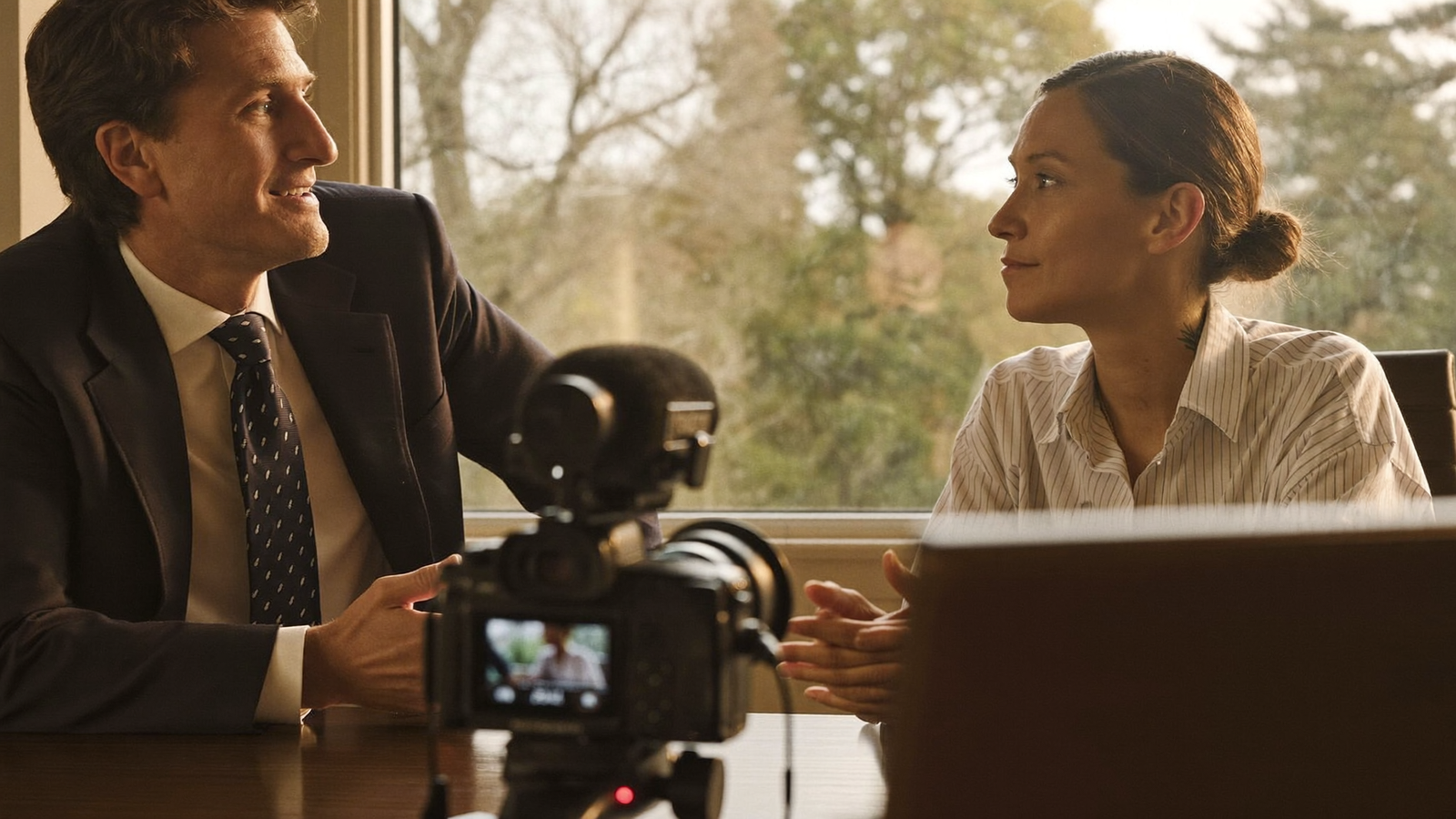
Multicam production changes the experience for the guest as much as the viewer. Two or more angles cut together, proper lighting, and an editor shaping the conversation for pace rather than leaving it as a raw fifty-minute recording produces something that reads as considered rather than defensive.
Signal Hill Insights' 2025 video podcast brand lift research, covered in more detail in our piece on production quality for a B2B video podcast, found lifts in upper-funnel brand metrics for video podcast campaigns consistently exceeded the firm's benchmarks for audio-only. Format is doing real work here, not just aesthetics.
The interviewing matters as much as the camera setup. A host who asks the safe, expected question gets the safe, expected answer, and that answer is what makes a podcast forgettable.
A host who is willing to push, follow up, and let a guest actually think out loud gets something a listener will remember. That is a production and format choice a firm's production partner should be actively shaping, not something left to whoever happens to be holding the microphone that day.
The compliance step is a workflow question, not a reason to avoid video
Regulated firms have a genuine constraint that other businesses starting a podcast don't. The Solicitors Regulation Authority's Code of Conduct requires that any publicity relating to a firm's practice is accurate and not misleading, which in practice means episodes touching legal advice, case outcomes, or regulated commentary usually need a review pass before release. Accountancy and financial services firms face equivalent obligations from their own regulators.
This is a scheduling problem, not a format problem. It means building time between the final edit and the publish date for a compliance or risk contact to review, and briefing guests on what they can and can't say before recording. That is better than relying on them to self-censor mid-conversation, which is usually what produces the stilted, over-careful tone firms are trying to avoid in the first place.
A production partner who has worked with regulated firms before builds that review window into the schedule by default, rather than treating it as a surprise that delays release.
The bottom line
A law firm or professional services podcast has the easiest path to working when the firm already has real relationships to reinforce and a genuine point of view to put on record. It has the hardest path when the goal is unspecified brand awareness with no clear audience in mind.
Get those two things right, budget for what a properly produced episode actually requires, and build the compliance review into the schedule from day one. Do that, and the format does what it's supposed to: keep the firm visibly credible to the people who already decide whether to send it work.
If your firm is weighing up whether a podcast is worth doing properly, get in touch and we'll talk through what that actually takes.