
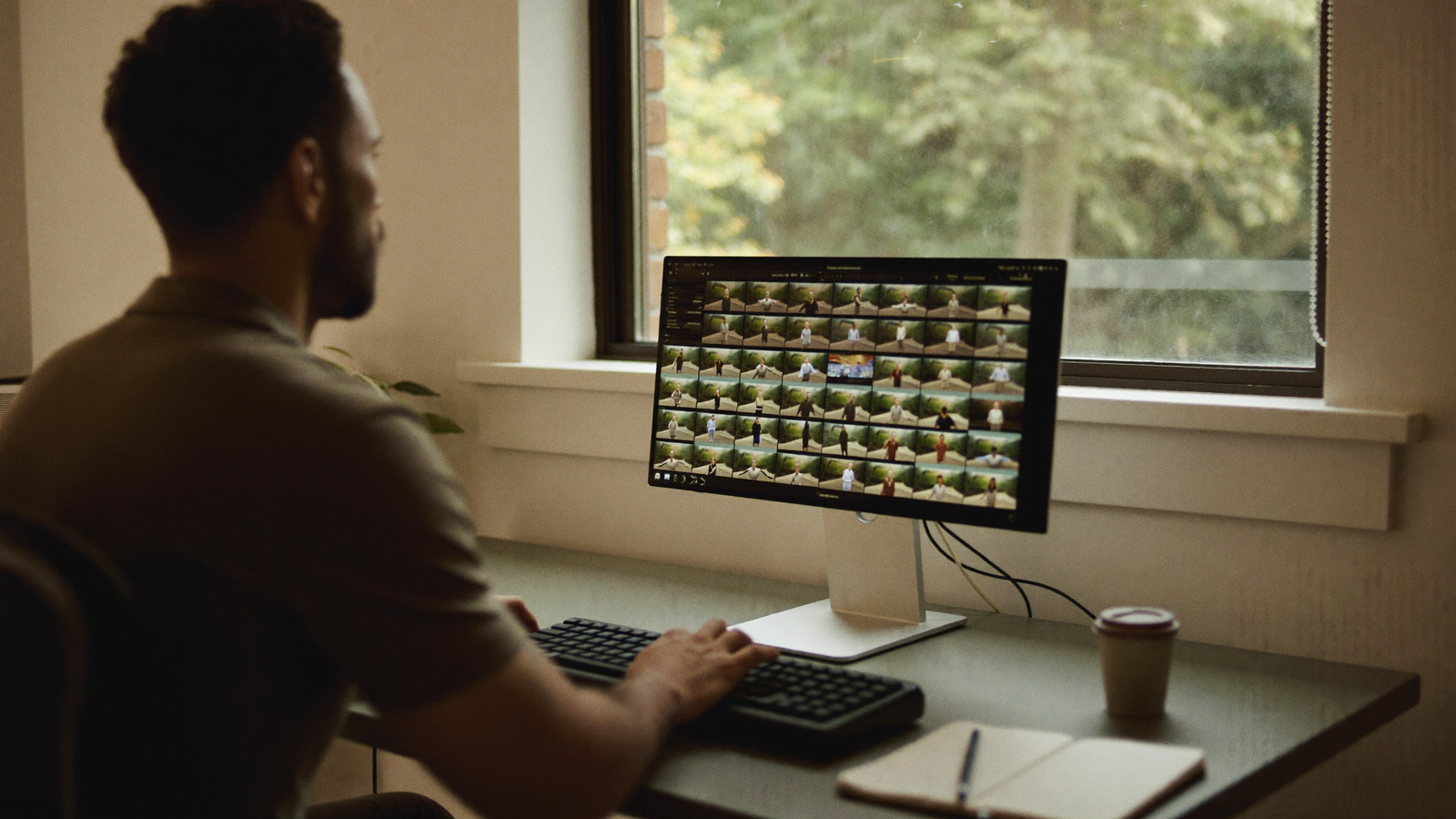
The honest answer is: longer than most in-house teams expect, and considerably longer than most initial estimates assume.
The gap between expectation and reality is one of the most common reasons organisations end up abandoning their podcast. Not because the content was bad, but because the production workload accumulated until someone decided it was not sustainable.
The audio editing baseline
Start with audio-only, because it sets the floor.
Professional podcast editors report that audio editing takes between three and five minutes of work for every minute of recorded audio. A 30-minute podcast episode recorded with two participants requires between 90 and 150 minutes of audio editing alone. That is before any music, intro, outro, or transcript. Before any social assets. Before any publishing workflow.
For a person doing this alongside a full-time role, editing a 30-minute audio episode takes the better part of a half day, every single episode.
This is the minimum. Audio-only editing with a single speaker or two speakers, removing errors and dead air, balancing levels, adding music. A 45-minute episode with several guests, multiple audio sources, and more complex pacing can easily take four to six hours.
Most in-house teams underestimate this number because they think of podcast editing as similar to editing a written piece: a review pass, a few cuts, done. Audio editing is a different skill, operating at a different time scale.
What video adds to the equation
Video does not just multiply the editing time. It adds entirely new layers of work that audio editing does not require.
The first is synchronisation. A multicam video podcast with two or three cameras and separate microphone tracks for each participant needs all feeds aligned to a common sync point before any editing can begin. This is a technical step, and it can take 20 to 40 minutes for a typical two-person setup before a single creative cut has been made.
The second is the multicam edit itself. Rather than working with a single audio waveform, the editor is switching between camera angles to follow the conversation: cutting to the speaker, using the wide shot for reaction, adjusting timing so cuts feel natural rather than mechanical. Experienced multicam video podcast editors report the full edit of a two-person episode previously took three hours per episode, and that was before adding social clips, thumbnails, and platform-specific exports.
AI editing tools have compressed some of this time. Multicam-cutting tools like AutoPod can handle the initial camera-switching pass in a fraction of manual time. But the tools require oversight, manual refinement, and quality checking. The total time saved is real; the total time required is still substantial.
The full production workflow for a video episode
Here is what producing a single video podcast episode actually involves, broken into stages.
Pre-edit preparation: Downloading or receiving files from all participants. Organising camera and audio tracks. Merging camera and microphone files so they travel together in the edit. Creating the project file and folder structure. Time: 20 to 45 minutes.
Synchronisation and quality check: Syncing all camera and audio tracks to a common point. Reviewing audio levels, spotting any major recording problems. Applying basic audio processing: noise reduction, EQ, compression. Time: 30 to 60 minutes.
Multicam cut: Switching between camera angles to follow the conversation. Trimming for pacing and removing errors. This is the creative core of the edit. Time for a 45-minute conversation: two to four hours.
Titles, intro, and outro: Adding the episode intro sequence, lower thirds identifying speakers, any mid-episode segment breaks, and the outro. For a templated show with established assets, this is faster; for a new episode with different guests, it takes longer. Time: 30 to 60 minutes.
Audio mastering: Final audio pass to ensure loudness levels are consistent with platform standards. Checking levels across the whole episode rather than just clip-by-clip. Time: 20 to 30 minutes.
Thumbnail: Selecting a frame from the video that works as a still, or taking dedicated stills during recording. Designing the thumbnail to match the show's visual style. Exporting at the correct resolution for YouTube and other platforms. Time: 30 to 60 minutes.
Social clips: Identifying three to five short moments from the episode. Cutting each to portrait format for LinkedIn, Instagram Reels, and YouTube Shorts. Adding captions, branding, and any text overlays. This is a separate editing pass, not a quick export. Time: 60 to 120 minutes.
Trailer: A 60 to 90 second episode trailer cut from highlights. Required for distribution to podcast apps and useful for social promotion. Time: 30 to 60 minutes.
Export and delivery: Rendering the full episode, all social clips, and the trailer at the appropriate file sizes and formats. Uploading to relevant platforms. Writing show notes. Time: 30 to 60 minutes.
Total time for one episode: in the region of six to ten hours for an experienced post-production team working on a well-established show, and longer for anyone learning the workflow for the first time.
Why in-house estimates are usually wrong
The estimates that marketing teams make before taking on podcast production tend to undercount in three ways.
First, they focus on the edit itself and treat everything else as overhead. The sync work, the thumbnail, the social clips, the trailer: these are not overhead. They are the deliverables. A video podcast episode that is just the main edit and nothing else is not a complete post-production package. It is the raw material.
Second, they assume that learning the workflow is a one-time cost. It is not. Multicam video editing has a significant skill curve. It requires familiarity with non-linear editing software, audio processing, colour grading, export settings, and platform-specific requirements. Someone without that background will not produce professional results quickly, and the time they spend building those skills is time taken from other work.
The third issue is consistency. A podcast episode produced every two weeks means the editing workflow runs every two weeks, indefinitely. The total annual time commitment for a fortnightly 45-minute episode is in the range of 150 to 250 hours of post-production work per year. For a senior marketing manager or communications professional, that is the equivalent of four to six weeks of full-time work devoted purely to editing.
The outsourcing calculation
The case for outsourcing video podcast production is not primarily a cost calculation. It is a time-and-quality calculation.
A specialist post-production team with an established multicam workflow will produce consistent results faster than an in-house generalist learning the process. The organisation gets professional output without diverting internal resource from its core work.
The question is not whether the in-house team could do it. Many could, given sufficient time. The question is whether the time required represents the best use of their hours, week after week, at the quality level the show needs to achieve.
The bottom line
Producing a video podcast episode, done properly, takes somewhere between six and ten hours of skilled post-production time. That includes the multicam edit, audio mastering, thumbnail, portrait-format social clips, and trailer. Not as a one-off. As a recurring commitment, every episode, for as long as the show runs.
This is not a reason to avoid producing a video podcast. It is a reason to be clear-eyed about what it requires.
Those hours are what you are buying when you outsource. Our podcast editing services cover the full six to ten at £400 per episode.
If you are working out whether to handle podcast post-production in-house or hand it to a specialist team, we can walk you through what that looks like in practice.