
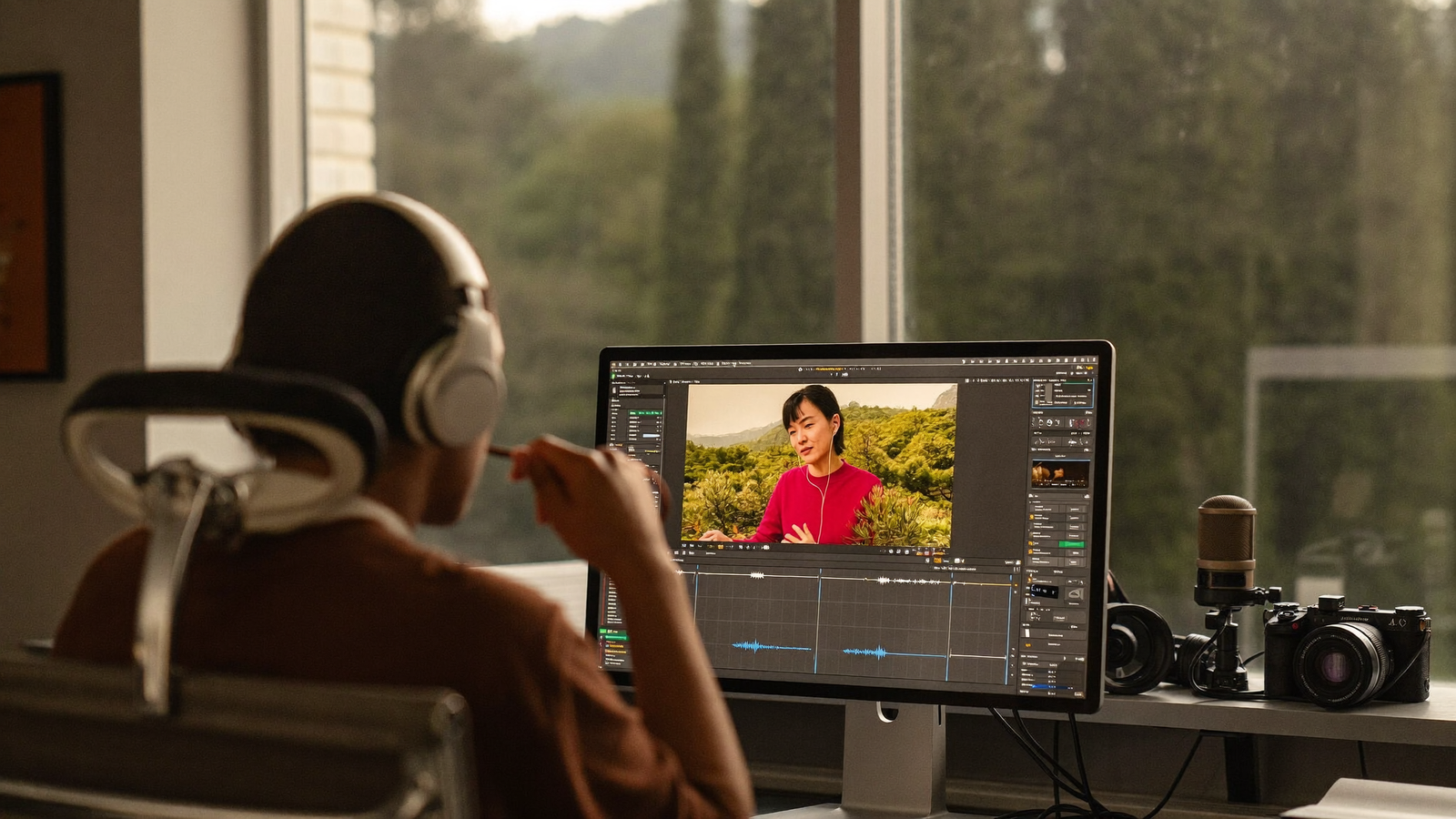
Put headphones on, play sixty seconds from the middle of your last episode, and ask one question: does this sound like real people talking? If the answer is "not quite," your editor's AI tools may be doing more of the work than they should.
This is not a theoretical concern. AI now sits somewhere in almost every podcast editing workflow. Used well, it saves hours on genuinely repetitive tasks.
Used carelessly, it flattens a conversation until the people in it stop sounding like themselves. The question worth asking is not whether your editor uses AI. It is which decisions a person still makes, and who signs off on the final cut.
What over-processed audio actually sounds like
Resonate Recordings, a US B2B podcast production agency, published a practical breakdown of this problem in October 2026, built from the test edits it gives every editor who joins its team. The symptoms it describes are specific enough that anyone can listen for them, no audio training required.
Pauses disappear and speech feels rushed, because silence and filler-word removal has been set too aggressively. The room goes completely silent between words, a sign of heavy noise reduction or gating. Every sentence sits at almost the same volume, which usually means compression or limiting has been pushed too far.
S sounds turn soft or lispy from aggressive de-essing. Volume swells and shrinks oddly around louder words, a sign the processing is overworking the file.
None of these are dramatic on their own. That is exactly the problem. Each one is small enough to miss in isolation, and the combined effect is a conversation that is technically clean but no longer sounds like a conversation.
Resonate's own rule of thumb: one issue is worth a question to your editor, two or more is worth a closer look at the processing.
The test, adapted for video
That listening test transfers directly to audio-only shows. A video podcast has a second layer worth checking, because the same automation that trims silence in audio now drives a lot of auto-cut video tools too.
Automated jump-cut editors work by detecting silences and filler words in the audio track and cutting the video to match. OpusClip's own guide to these tools is candid about the risk: its key takeaways include "always review AI-generated cuts before finalizing to ensure natural pacing and avoid removing important pauses or context."
Different content also needs different cutting aggressiveness. A long-form conversation needs more room to breathe than a fast-cut social clip.
Watch for the video-specific version of the same drift. Reframing that jumps on every speaker change rather than following the actual rhythm of the exchange. Caption timing that is technically accurate but reads half a beat ahead of or behind what is being said.
Cuts so tight that a guest's reaction, a laugh, a pause before answering a hard question, gets trimmed away because the tool read it as dead air rather than content. A multicam edit should follow the conversation, not impose a pace on it that nobody in the room actually spoke at.
Why this matters more for a B2B show
For a consumer entertainment podcast, over-processed audio is an aesthetic complaint. For a B2B show, it is closer to a credibility problem.
Your guest is often a client, a senior figure in your sector, or someone whose time and reputation you have borrowed for forty minutes. If the finished episode makes them sound stiff, oddly even, or slightly synthetic, that reflects on them and on the show that published it.
This is also where we've always drawn the line on production: editorial craft over algorithmic optimisation. That is not a rejection of AI.
Transcription, noise cleanup, and flagging likely filler words are genuinely useful technical passes, and refusing to use them well would just be slower, not more honest. The line sits at the next step: a tool can flag a pause, but a person has to decide whether that pause was someone thinking or someone stalling, and whether it belongs in the final cut.
The right question to ask is not "do you use AI"
Almost every production partner uses AI somewhere in the pipeline now. CoHost's 2026 State of Podcast Agencies report, covered by Podnews, found that 92% of agencies use AI in some part of their workflow, most commonly for transcription, show notes, and audio editing. Asking whether a partner uses AI at all will get you the same answer from almost everyone.
The more useful question is which decisions AI is allowed to make unsupervised, and who listens to the result before it goes out. A partner should be able to answer in a sentence: AI handles the first pass on noise and filler flags, a person reviews every cut for pacing and tone, and a named editor signs off before delivery. A vague answer, or one that dodges the "who listens" part, tells you something too.
It is a fair question to raise before you commission a series, not just after you notice something sounds off. Our podcast editing services page sets out exactly where the human judgement sits in our own process, which is the kind of detail worth comparing across any shortlist.
The honest limit of this test
Your ears can tell you something sounds over-processed. They cannot prove AI caused it. Old-fashioned heavy compression produces several of the same symptoms, flat dynamics and a vanishing room tone chief among them, and has done since long before AI editing tools existed.
There is also no single number, no specific decibel reading, that marks the point where "clean" tips into "too clean." It depends on the voices, the room, and even what you are listening on.
Treat the test as a reason to ask your editor a direct question, not as a verdict you deliver to them. The goal is a conversation about where the processing sits, not an accusation about a tool.
The bottom line
Run the sixty-second test on your own show before you ask anyone else to. If two or more of the symptoms above show up, the question is not whether your editor used AI. It is what they let it decide without checking.
A credible production partner will tell you exactly where that line sits in their own process, without needing to be asked twice.
The businesses that get this right are not the ones avoiding AI. They are the ones who have been explicit, with their team and with themselves, about what a tool is allowed to decide and what still needs a person's ear on it.
If you want to know exactly where the human judgement sits in how we edit, get in touch.